Narrative design
The Choice Map: A Practical Framework for Interactive Short Drama
A Choice Map adds dramatic causality and production obligations to a branching graph, giving writers, directors, editors, and reviewers one shared account of what every viewer decision must change.
By Taplot Editorial · · 9 min read
A branching graph can be perfectly connected and dramatically empty. It can prove that option A reaches scene 12 and option B reaches scene 14, yet leave the creative team unable to explain what the viewer decided, what either scene must answer, or what remains different when the routes meet again. The arrows are correct. The experience is not.
Taplot’s Choice Map is a working framework for closing that gap. It is not an established industry standard. It is our method for placing dramatic causality beside story topology before scripts become performances, shots, edits, and tested routes. Topology tells a team what can follow. Dramatic causality tells them what must be felt, remembered, and paid off because a viewer chose.
Each decision becomes a seven-field production contract: pressure, competing intentions, immediate answers, remembered state, downstream payoff, route shape, and production obligation. Together, those fields let a writer, director, editor, producer, and reviewer inspect the same promise from different parts of the work.
Topology is necessary; causality makes it drama
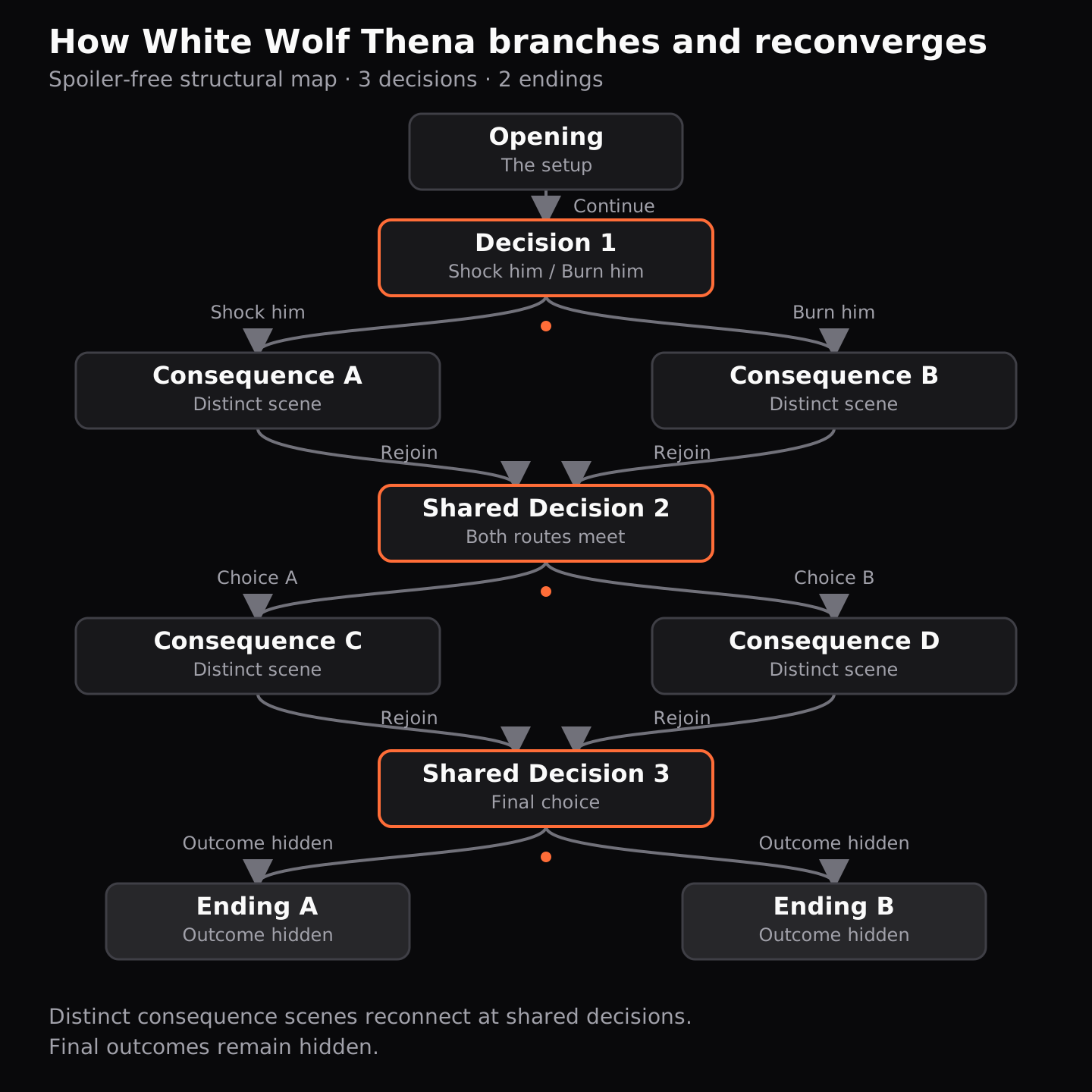
A graph records reachability. The Choice Map records the causal promise that must survive those connections: what the viewer owns, where the story first answers, what remains different, and where that difference returns. A route can pass a connectivity check and still fail this causal trace.
First decide whether the choice deserves to exist
The earlier standard answers whether a decision earns its place. The Choice Map begins only after the answer is yes: it records what each department must preserve while that decision becomes a produced and tested route.
The five-field dramatic promise
The first five fields form a traceable chain: pressure → intentions → immediate answers → remembered state → payoff. This is not a plot summary. It is a compact account of what the audience knows at the pause, what they are being asked to own, and how the released story will prove that it listened.
1. Pressure: why must the choice happen now?
Record the situation at the exact moment playback pauses. What does the protagonist want? What changed in the last beat? Why is waiting no longer neutral? Which crucial fact remains unknown? Pressure determines the timing of the interruption.
Write from the viewer’s current knowledge, not the author’s completed outline. “The guards are approaching, and she must decide whether to trust him” is usable. “He is secretly innocent, so trust is correct” contaminates the map with future information. The team must evaluate the choice the audience receives, not the answer key the writer already knows.
2. Intentions: what is the viewer choosing to mean?
Record the intention beneath every button label. “Open the door” might express trust, desperation, defiance, or an attempt to gather evidence. The physical action alone is insufficient; the intention tells the next scene what it must answer.
Strong options compete at the level of value or strategy: tell the truth versus protect someone, escape versus stay for information, forgive versus demand accountability. When two labels conceal the same intention, the branch may be navigation rather than drama.
3. Immediate answer: how does the scene acknowledge the selection?
The immediate answer is the first visible or audible proof that the story received the choice. It does not need to reveal the full consequence. It does need to convert intention into an event, reaction, or changed situation before the causal connection becomes obscure.
Write a producible beat. “Tension rises” gives a director and editor little to work with. “She names the thief; her ally steps away and denies knowing her” specifies action, performance, and a new problem. The viewer should recognize the story’s answer without needing an interface message.
4. Remembered state: what remains different?
State is the durable difference carried beyond the immediate answer: trust lost, evidence revealed, an injury sustained, an ally recruited, a secret preserved, a route opened, or an ending closed. It may be represented in software, performance continuity, dialogue, or simply in which scene becomes reachable.
Do not add state because a system can store it. Add state because the drama can express it. A hidden score that never changes a reaction, option, interpretation, route, or outcome is bookkeeping without narrative memory.
5. Payoff: where does the story remember in public?
Payoff is the later beat where remembered state becomes legible again. It can be a changed line in a shared scene, access to another option, a relationship response, withheld information, or an ending that resolves the viewer’s earlier position. Record both its location and its form.
Distance raises the burden of clarity. If several decisions separate cause from payoff, preserve the thread through recurring dialogue, objects, performance, or a visibly changed relationship. Mystery about what the consequence will be can create suspense. Confusion about whether the story remembered creates distrust.
Two execution fields keep the promise producible
6. Route shape: where will the difference live?
Taplot uses four working labels. A local branch delivers a distinct beat and returns to shared pressure. A stateful reconvergence returns to a shared location while carrying a difference into dialogue, access, or interpretation. An extended branch continues through another scene or decision. A terminal branch resolves the current route in an ending.
These labels describe scope, not quality. An extended route is not more meaningful than a local branch; it is simply longer and harder to keep coherent. Choose the shortest shape that can honor the dramatic promise. A visually impressive graph is not a creative objective.
7. Production obligation: what must be made different?
Every route creates obligations across script, performance, blocking, visual continuity, footage or generated media, sound, edit, language versions, and playback testing. Record each obligation as a countable deliverable with an owner and acceptance evidence; also mark what may be shared without erasing the viewer’s decision.
For example: Route A requires one reaction close-up and one alternate line in the later scene. Route B requires one response beat and one refusal variant. Both routes share one set of doorway coverage and the escape blocking. The producer assigns an owner to each unique deliverable, the editor records the accepted cut timecodes, and route review confirms both knowledge states.
Row header and sign-off
Keep the seven fields as the dramatic core, then attach five pieces of execution metadata. This header identifies the exact decision artifact; the sign-off shows whether its obligations survived production.
- Choice ID and source: a stable identifier plus the source scene and script beat or cut timecode.
- Exact option labels: the final viewer-facing copy beside the intention each label expresses.
- Owner: the accountable person for every unique production obligation.
- Status: proposed, approved, produced, or verified.
- Evidence: the relevant script page, shot or asset ID, accepted cut timecode, and playable route.
A row is ready for production only when every obligation has an owner. It is verified only when both options can be traced through the final playable cut and the header points to the evidence.
One hypothetical row
Suppose a protagonist has stolen evidence to protect her brother. A detective knocks and demands the missing file; her partner has seconds before opening the door. The decision is “Tell my partner the truth” or “Ask my partner to hide the file.” A Choice Map row might read:
- Pressure: the detective is outside the door, the file is visible, and the partner must act before knowing why it was stolen.
- Intentions: risk the brother’s safety through honesty versus protect him by enlisting the partner without explanation.
- Immediate answers: the truth makes the partner choose knowingly to hide the file; concealment forces the partner into the lie before understanding its cost.
- Remembered state: the partner either knows the truth and has chosen to help, or has been implicated without informed consent and no longer trusts the protagonist.
- Payoff: in the later escape, the partner either gives an alibi willingly or hesitates or refuses after discovering the manipulation.
- Shape: stateful reconvergence into the same escape scene, with different dialogue and willingness to help.
- Obligation: Route A requires one informed-consent reaction beat and one willing-alibi line; Route B requires one concealment response beat and one hesitation or refusal variant; shared deliverables are the doorway coverage, file-prop continuity, and escape blocking; route review runs one playable test for each knowledge state.
The row does not replace a screenplay, shot list, edit map, or technical graph. It gives those artifacts a common causal spine. If the later exchange cannot be produced, the team can shorten the remembered state, change the route shape, or redesign the choice before sunk work makes the decision expensive to repair.
A shared working document, not a writer’s private outline
The writer proposes pressure, intentions, memory, and payoff. The director determines how the immediate answer becomes visible in behavior, framing, and blocking. The editor protects the relationship between selection and response, especially when a payoff is delayed. Production identifies unique assets and continuity obligations. Reviewers trace each option from promise to delivered route.
That division of labor is why plain language matters. If a row depends on terms only its author understands, it cannot coordinate the team. The map should be revised whenever a performance, location, edit, or scope decision changes the causal chain; otherwise it becomes a design artifact that describes a story no one is making.
Cross-role sign-off
- Writer: pressure, exact option copy, remembered state, and payoff are approved.
- Director: both immediate answers are visible in performance and blocking.
- Editor: selection-to-answer timing and later payoff remain legible in the accepted cut.
- Producer: unique and shared deliverables have owners, counts, and approved scope.
- Route reviewer: both playable paths match the row and its supplied evidence.
Sign off first at production approval, then again on the playable cut. The first pass confirms that the plan is owned and affordable. The second confirms that each department preserved the same causal promise in the released route.
The Choice Map is a promise ledger
The Choice Map succeeds when every department can point to the same causal promise in its own work—from option copy to performance, continuity, cut, and playable route. Its value is not another diagram. It is a shared record of what the viewer’s decision obliges the production to deliver.