Interactive storytelling
How Interactive Stories Work: Choices, Branches, and Multiple Endings
A plain-language guide to how an interactive story moves from setup to choice, consequence, branching paths, endings, and replay.
By Taplot Editorial · · 9 min read
An interactive story works by presenting a dramatic situation, pausing at selected turning points, and letting you choose what the character does next. Your answer sends the story along a planned route. The next scene may respond immediately, the effect may appear later, or the route may end with a different outcome. Choices, branches, and endings are connected parts of one experience, not separate features added on top of a video.
Taplot’s How It Works page gives the short viewer loop: watch, choose, follow the consequence, and replay. This guide looks more closely at what connects those steps. We will use White Wolf Thena, a published Taplot fantasy story with three decision points and two endings, because its verified structure shows branching and reconvergence without requiring an ending spoiler.
1. The setup gives the choice meaning
Before a story asks you to decide, it has to establish a problem worth deciding about. The setup introduces the character, the goal, the pressure, and the information available at that moment. A choice means little when it appears without context. It becomes dramatic when each option expresses a believable response to the same conflict and asks the viewer to decide what matters now.
White Wolf Thena places the viewer in Thena’s role as she confronts Viktor, decides how to wield her wolf power, and eventually faces a question about his fate. The opening plays before any input is required. Its job is to establish the characters and the power at stake, so the first choice arrives as part of the drama rather than as an unrelated poll over a video.
2. A decision point turns intention into action
At a decision point, playback pauses and the story offers a limited set of actions. Each option is connected to what happens next. The options should express different intentions, not merely use different words. A viewer might choose restraint or force, trust or suspicion, confrontation or retreat. Good wording makes the action clear without explaining its result: a hidden solution key would remove suspense, while a vague label would make the consequence feel arbitrary. Once an option is selected, the story follows the route assigned to it.
The first decision in White Wolf Thena asks, “How do you want to handle the wolf?” The available answers are “Shock him” and “Burn him.” The labels are brief, but they clearly commit Thena to different actions. The viewer is not inventing an unlimited response; they are choosing between two authored possibilities that belong to the same turning point.
Agency in this format is focused rather than absolute. The creator still defines Thena, Viktor, the world, and the available options. The viewer controls selected dramatic decisions inside that authored structure. This boundary keeps the character and story coherent while making the viewer responsible for the route taken at important crossroads.
3. Consequences can appear now or farther downstream
An immediate consequence is the response shown directly after a choice. It confirms that the story heard the viewer. The response does not have to transform the whole plot at once. It needs to make the relationship between the selected action and the next beat visible, whether that means a different scene, conversation, location, confrontation, or piece of information.
The verified White Wolf Thena graph sends “Shock him” and “Burn him” into two different consequence clips. Both clips are real, playable media, but their contents do not need to be revealed here. That is the immediate layer: the selected action changes which clip the viewer sees next. The downstream layer comes afterward, because both clips lead to the same second decision rather than determining the ending on their own.
A downstream consequence does not have to be a hidden score. It can be structural: a route reaches another decision, gains or loses access to a scene, carries different context into a shared moment, or helps determine an ending later. Some stories also remember relationships, promises, or items, but that mechanism varies by title. The important question is whether the earlier choice changes what the viewer can see, know, attempt, or reach.
- Immediate consequence: the next scene responds to the selected action.
- Downstream consequence: the route affects a later opportunity, decision, or outcome.
- Shared destination: different routes can arrive at the same later decision.
- Ending: the route eventually stops at one of the story’s terminal outcomes.
4. Branches can separate and meet again
A branch begins when two or more options lead to different next steps. Those routes do not need to remain separate forever. They may meet again at a shared scene or decision, a structure called reconvergence. Reconvergence lets the story acknowledge different choices without doubling every later scene, decision, and ending indefinitely.
White Wolf Thena demonstrates this twice. The first decision opens two distinct consequence clips, and both routes reconverge at the shared second decision. The second decision then branches into another pair of distinct consequence clips, and those routes reconverge at the shared third decision. The structure is easy to follow: one setup, a choice, two possible scenes, and a common place where the story asks what happens next.
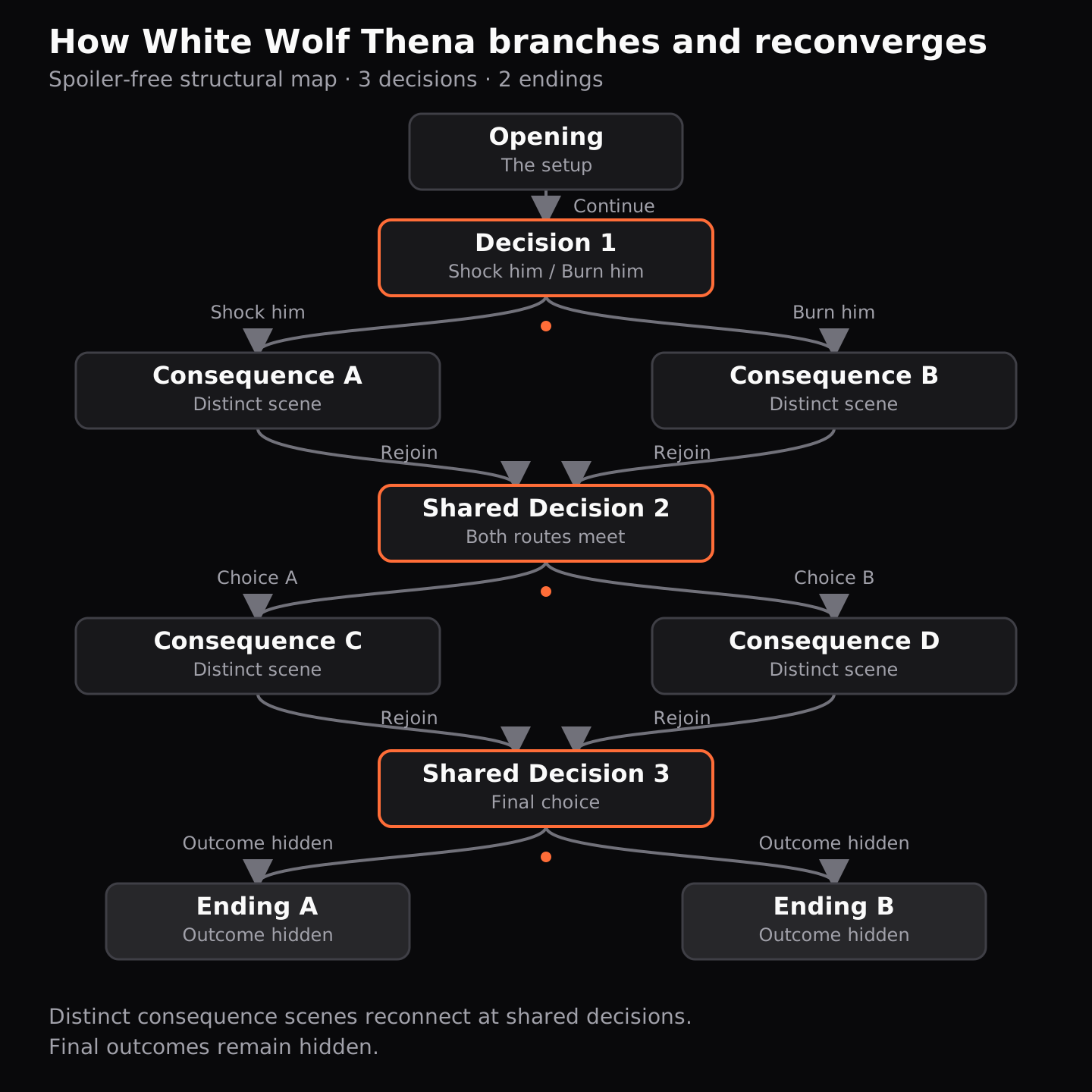
Reconvergence is not automatically evidence of a cosmetic choice. The real test is what happens before the routes meet. If different labels always produce the same scene and meaning, the choice may not feel consequential. In this verified example, each branch points to a different media asset before returning to a shared decision. The immediate experience changes even though the wider story remains manageable.
This is why an interactive story is better pictured as a road network than an endlessly splitting tree. Some roads separate briefly and rejoin. Some lead to another fork. The final routes may end in different places. The shape is planned and finite, and a meaningful branch does not need to become a separate feature-length story.
5. Ending logic closes the route
An ending is a point where the current route stops and resolves its immediate dramatic question. Different stories choose endings differently. One option may lead directly to an ending. A final decision may select between outcomes. Or a story may consider information gathered across earlier choices. Multiple endings simply means that more than one ending can be reached; it does not mean every possible sequence receives a completely unique finale.
The public data for White Wolf Thena reports three decisions and two endings. Its third decision presents a final Yes or No choice, and the verified graph points to two different ending clips. Which answer leads to which ending is deliberately left out here. The important structural fact is that earlier branches reconverge before this final choice, so several possible routes can arrive at a shared decision and then finish at one of two endpoints.
This distinction prevents a common misunderstanding. Two options at three decisions do not require eight independent endings. A story can provide different immediate scenes, bring routes back together, and reserve its largest split for the final outcome. More branches or endings are not automatically better; the value comes from a clear relationship between choice and resolution.
6. Replay lets you test the road not taken
On a first playthrough, you decide with incomplete information. You choose one action, see one consequence clip, and continue from there. Replay changes the question. Instead of asking only what should happen now, you can return to the same decision and ask what the unchosen route would show. Knowledge from the first attempt becomes part of the second.
In White Wolf Thena, replay can compare the two first-decision consequence clips without changing the fact that both reach the shared second decision. A later replay can test the other branch after decision two, or take the other final option to reach the story’s second ending. The graph provides several routes through a finite set of scenes, giving the viewer concrete alternatives without promising that the story expands forever.
What to notice while you play
You do not need to calculate a story graph while watching. Follow the setup, choose the action that matches your instinct, and notice the response. After the route ends, look back at four things: what changed in the next scene, where different paths met again, which decisions remained shared, and how the ending closed the original conflict. You can enjoy the drama first and examine its structure afterward. Those observations reveal the design in ordinary viewer language.
If choices about power, danger, and forgiveness appeal to you, Taplot’s Fantasy story collection offers more interactive premises. Different titles use different numbers of decisions, branches, and endings, so the structure should be understood from the story you are playing rather than assumed from the genre.
Explore interactive fantasy stories
The complete path is now easier to see: the setup creates a meaningful problem; a decision expresses the viewer’s intention; an immediate consequence changes the next scene; a downstream connection carries the route onward; branches separate and sometimes reconverge; an ending resolves the route; and replay lets the viewer test another possibility. That is how an interactive story turns watching into participation without promising infinite branches.